
Week 1
I didn’t change anything this week about the lessons because I had to do a lot of reviewing expectations and procedures, so my mental capacity was pretty full. Changing up the lessons to fit best practices while also maintaining the integrity of the curriculum is challenging, and I just didn’t have it in me. However, I knew that I needed to start putting my own spin on lessons in order to see the same amount of growth, or higher, that we saw last year.
We did have a lot of really great conversations though, especially since we started this unit right after the No Kings protest. It was cool to be able to show students a real life example of protesting – it made the unit more relevant to them.
Week 2
I have been integrating Reciprocal Teaching this year, and have loved how deep it has caused my students to think about the text. This week, I wanted to try the close-reading strategy that Lori D. Oczkus shares in her book, Reciprocal Teaching at Work: Powerful Strategies and Lessons for Improving Reading Comprehension. Initially, I was really skeptical about having my students read the text 4 times, but it led to some really wonderful conversations! These reads took place over 3 days.
First Read: Students predicted what the text was going to be about, and then followed along while I read it out loud to them. The purpose was to just listen for initial understanding.
Second Read: Students read the text with a partner and identified words or ideas that were confusing to them. Then, they shared them with the class so we could talk about the definition. This is where teaching them how context clues can sometimes be helpful comes into play, rather than teaching it in what feels like a disjointed lesson.
Third Read: Students read to question, meaning that they were reading and then asking a comprehension question to the class. This was such a great way for them to think like a teacher, which shows me that they have a deep understanding of what they are reading. It also holds their peers accountable, and led to some really great conversations about what the text was about.
Fourth Read: By this point, I could tell students were getting a little burnt out on the text, so I assigned each of my tables a section to summarize rather than making them read the whole thing. Then, each table group shared out their summary, while I wrote it down on chart paper to create a summary of the whole text. This also allowed me to notice that I needed to spend some more time on word choice and how to summarize nonfiction.
Since the re-reads hit so many skills that Benchmark wanted us to teach that week, the only lesson I felt like I needed to teach were lessons 8, 10, and 14. I feel like the re-reads allowed us to really dig in to the deeper concepts these lessons were teaching. I did skip AU Question 2, as I we had talked a lot about that already and didn’t want to make students do something they had already done.
Week 3
This week, I’m trying something new again. I signed up for a four-week thinkSRSD course geared toward Benchmark. I’d like to start implementing what I learn while I still have access to Leslie Laud. I had my first session earlier this week, and I walked away with so much knowledge already. Essentially, we are still taking students through a P(3)OWeR Cycle using one of the weekly Apply Understanding questions.
Day 1
Today I introduced vocabulary, had students make a prediction, and then we read the text through once just to understand it and get a feel for it.
Day 2
P1: We read through the text again, this time coming up with a gist statement.
P2: Once we had that, our next task was to pull apart the prompt, identifying the “Do” and the “What.” I chose Apply Understanding Question 1: How does Thurgood Marshall incorporate chronological connections to support his argument? Cite specific examples that show the relationships between events in the text. This felt like an easy introduction for both the students and myself.
P3: This step involves us picking ideas to write about based on what the prompt is asking us. I did have to guide my students a little bit to make sure that they were hitting the chronological order aspect, but they did extremely well with this part. We talked about events that happened before the speech, and events that were currently happening in the fight for equality.
Day 3
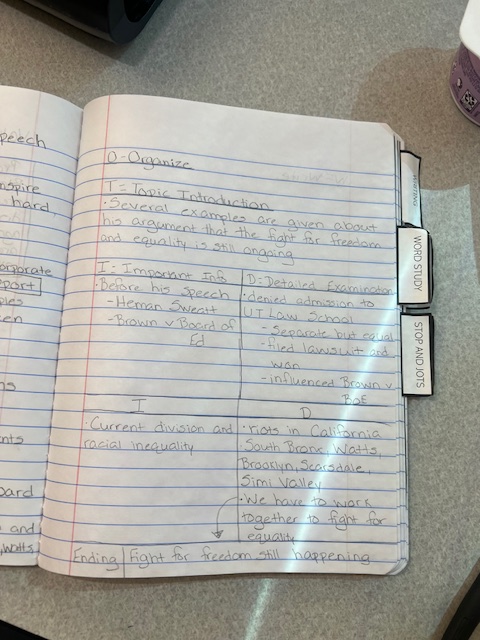
O: Now that we had our ideas, it was time to organize them into the TIDE planner. I didn’t have time to create an expected student response, so I was winging it with my students. However, I am still pleased with what they came up with! Definitely a lot of great thinking happening here.
Day 4
WeR: We took our TIDE organizer and turned it into a paragraph response. Since this was heavily scaffolded, we all wrote the same exact thing. I can’t wait to turn this over to students to see how well they are able to respond on their own. When we finished, we color-coded our answer to see how we turned our plan into a response. Looking at a rubric, we self-scored and then revised to make our writing stronger.
Day 5
This is a fun day because there are two options: Score an exemplar response and set goals or score a below grade-level response and revise up. I chose to have students revise up an example of a below grade-level response to show them how editing and revising works. Students are so hesitant to revise their writing, so I felt this was necessary so they could see that every piece of writing can always be revised up.
Reflection
I really like how Week 2 and Week 3 went, and am thinking about how to integrate the two methods together for Unit 4. I am excited to see my student’s comprehension and writing skills really take off using these strategies!
I highly recommend taking the thinkSRSD Benchmark Advance course, it is well worth the $199.
I can’t decide if I want to post weekly so that each Unit has three separate posts, or all in one post like this one. Leave a comment below to let me know what you prefer!

 The Blissful Teacher