It just so happens that our unit about the American Revolution comes right after this reading unit, so I am excited to see the connections that they make. This is one of my favorite Benchmark units because I love teaching about the Revolution, and that makes students get into it as well!
Day 1: We watched the introduction video, talked about the Essential Question, and learned how captions are related to images. Then, as with all previous units, we completed an ABC chart to activate our background knowledge. I got this activity from Activities for English Language Learners Across the Curriculum by Stephen White. Students love it, and some of the things they already know about amazes me!
This lead us into the first read of the text, with students using various strategies to support their comprehension as they read. If there’s time, I like to have students share what strategy they used with the class for accountability purposes.
Day 2: I had students determine the meaning of the suggested words using context clues, and then we co-created a Frayer model. I find it to be more impactful that way, and then we have something we can put on our Reading board for students to reference.
I teach the phonics lesson as it is written, as I think for this age it is written well. Most students don’t need to spend a crazy amount of time on these skills. Students who have gaps in their phonics skills receive more targeted intervention using UFLI during WIN time. Because we have a dedicated Phonics time in our schedule, I teach this lesson during that time. This meant I had extra time during our reading block, so I had students discuss the text structure. I have really focused on that this year because it is such an important 5th Grade skill.
Day 3: To be honest, the lesson about main idea and key details did not go well with my students this year. I don’t think I scaffolded it enough for them, so I have been thinking of ways to go back and review main idea and key details. I like to look through Jennifer Serravallo’s The Reading Strategies Book 2.0 to find different ways to teach reading comprehension strategies. There are a couple I have bookmarked to teach in a future lesson, so I will keep you updated on that.
I taught Lesson 8 as-is, but I want to rework it to be more accessible for students. My teammate did that for Lesson 12, and it went so much better. Next year, my hope is to be able to update this part of the post with some really great strategies. Just goes to show that not everything is a home run!
Day 4: Lesson 10 is the first read of “Road to Revolution” and again I had students choose a comprehension strategy they liked the best. Students shared their strategy with the class. I have a lot of artists in this class, so we got to see some really cool drawings of what they read.
My teammate did a really wonderful job of scaffolding Lesson 12 for students. We have talked about formal vs informal language all year, so rather than tell them that George Washington’s letter is formal I put the thinking on them. They have to decide which it is and find two examples to prove their answer. I ask them the same questions about Patrick Henry’s speech. Students then compare and contrast the language that is being used with their partner. I also changed the Turn and Talk question to: As America headed to revolution, how did the attitudes of George Washington and Patrick Henry differ? I find this really helps students focus on the actual language and the purpose of it, rather than the very conceptual question that Benchmark asks them.
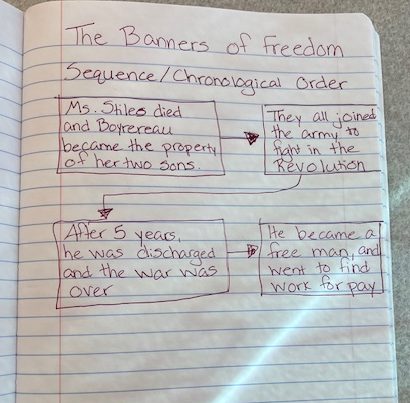
Day 5: We discussed how “Road to Revolution” is also a chronological/sequence text, and created a sequence map. Students then discussed how this structure helps the reader make sense of what they are reading. I then ask them how the information presented would change if it was written in a cause/effect or compare/contrast structure. This is slightly different from Benchmark’s wording, but again I find it to be easier for the students to understand.

 The Blissful Teacher