Now that I have used Benchmark for a full year, I feel a LOT more confident teaching it. I know what the students are supposed to get from each unit, and I have read a lot more about the Science of Reading which allows me to implement best practices. I am currently reading The Comprehension Blueprint by Nancy Lewis Hennessy and it has been a total game changer for me. I feel like I say that after every Science of Reading (SOR) book I read, but it really is true! I gain so much from each book and am able to incorporate more and more into my instructional practices.
This book has been about how to implement the Language Comprehension part of Scarborough’s Rope, and I recommend it to everyone! Once I finish the book I’ll have to do a post about it. Anyways, back to Benchmark…
This past week we finished Unit 1, Week 1 – all about corn! I changed the way I structured my week though, and I felt like my students got more out of it and they aren’t sick of corn yet! I’ll break it down lesson by lesson for you!
Lesson 1: We watched the introduction video, talked about the Essential Question, and learned how captions are related to images. Then, instead of moving on with the rest of the lesson, we completed an ABC chart to activate our background knowledge. I got this activity from Activities for English Language Learners Across the Curriculum by Stephen White. My students LOVED this activity, and they did such a great job with it!

Lesson 2: We made Frayer Models for vocabulary words that I chose from the text rather than the words that the curriculum chooses. I picked these words because I felt like they were the most important for students to know so they can understand the meaning of the text. This is called intentional-on-purpose teaching. I made one on large construction paper, and students copied it into their reading notebooks.

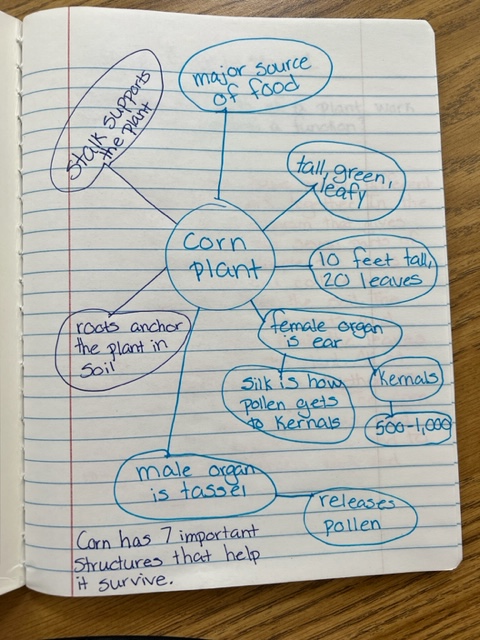
Lesson 4: We read “The Structure of a Corn Plant” on page 4 of their magazines, and I taught them enclosed, diameter, and embryo by using a synonym to explain the word as I read. According to The Comprehension Blueprint, these are incidental-on-purpose teachings: words that they need to know, but we don’t need to spend a lot of time on. We discussed the text structure, which we decided overall was descriptive, then made a graphic organizer to capture important information. We were able to use this graphic organizer to find the main idea, and they did so much better than my students last year did. The graphic organizers really are a game changer!
Lesson 7: We talked about how, within an informational text, there can be more than one text structure. We focused on the cause and effect relationship for paragraphs 1, 5, and 6. We made a graphic organizer, and again students did extremely well with this. They are feeling so successful, and I feel like they are really taking in the information Benchmark wants them to! They then completed the Connect Skills to Knowledge Turn and Talk and Apply Understanding Question 1, with my scaffolded sheets that you can purchase in my TPT Store.
Lesson 10: I followed a similar introductory structure with the second text, but we didn’t make Frayer Models. I picked words that showed up in both texts to make them in Lesson 2. We discussed the text structure, cause-and-effect, and made a graphic organizer to capture the main idea and key details. My teammate and I decided to skip the mental images part of the lesson because we really want to focus on using the text structure to help students understand a text.
Lesson 12: We didn’t really change this much as we felt that it was a really important skill for 5th graders to have. However, I do feel like my students this year did so much better than my students last year because we spent the extra time focusing on text structure to find the main idea. They were easily able to grasp what was being asked of them because we spent so much time building their background knowledge and making sense of the text.
Unfortunately, we didn’t get to Lesson 13 or 15 this week, but because the curriculum spirals so much we really aren’t concerned about it! We did touch briefly on how the authors of the persuasive texts are trying to persuade them to believe their side, but didn’t do an in-depth look at it. Even though we didn’t get to everything, I feel really good about what we did this week because my students walked away with a lot of knowledge on the two texts they did read. Since week 2 only has one text, it will be easier to get to more of the skills-based practice. I plan on following a similar structure for this text. I will keep you updated on what we do!

 The Blissful Teacher